
One of the core ideas behind Journablend and The Blend Flow is that journaling doesn’t have to be complicated, structured, or perfect to be genuinely helpful.
Instead, The Blend Flow is the simple rhythm I naturally return to in my own everyday journaling practice – a way of blending planning, reflection, creativity, and mindfulness together in a gentle, supportive way.
Rather than following rigid systems or trying to “do journaling properly,” The Blend Flow is designed to help you work with your real life and real mind as it is.
At its heart, the flow moves through five simple steps:
Braindump, List, Engage, Nourish, and Daily – or simply, BLEND.
Together, these steps support different parts of everyday life:

In a previous post, I talked about the Braindump step – the practice of getting everything out of your head and onto paper without overthinking it first. You can read the post here if you’re interested → B is for Braindump.
Essentially, that step is all about release.
This post, however, moves into the next part of the flow:
L is for List.
And while lists might seem simple on the surface, this is often the step where a little more clarity and direction begin to appear.
After the Braindump step – where thoughts, worries, reminders, ideas, and mental clutter all land freely on the page – lists help gently sort through what’s there.
As a result, this is where I start asking:
For me, lists are not about rigid productivity or trying to organize every minute of life. Instead, they’re a way to create a little more space in the middle of everyday life.
Some days my lists are practical.
Some days they’re reflective.
Sometimes they’re messy and unfinished.
And sometimes they simply help me feel a little calmer.
More often than not, they help me reconnect with myself and what matters most.
The Braindump step helps release what’s swirling around in your mind.
The List step, on the other hand, helps bring a little gentle structure to it.
Once everything is on paper, I can begin asking:
At this point, lists become less about “getting everything done” and more about creating direction.
Even a very simple list can help things feel more manageable because you’re no longer trying to carry everything mentally at once.
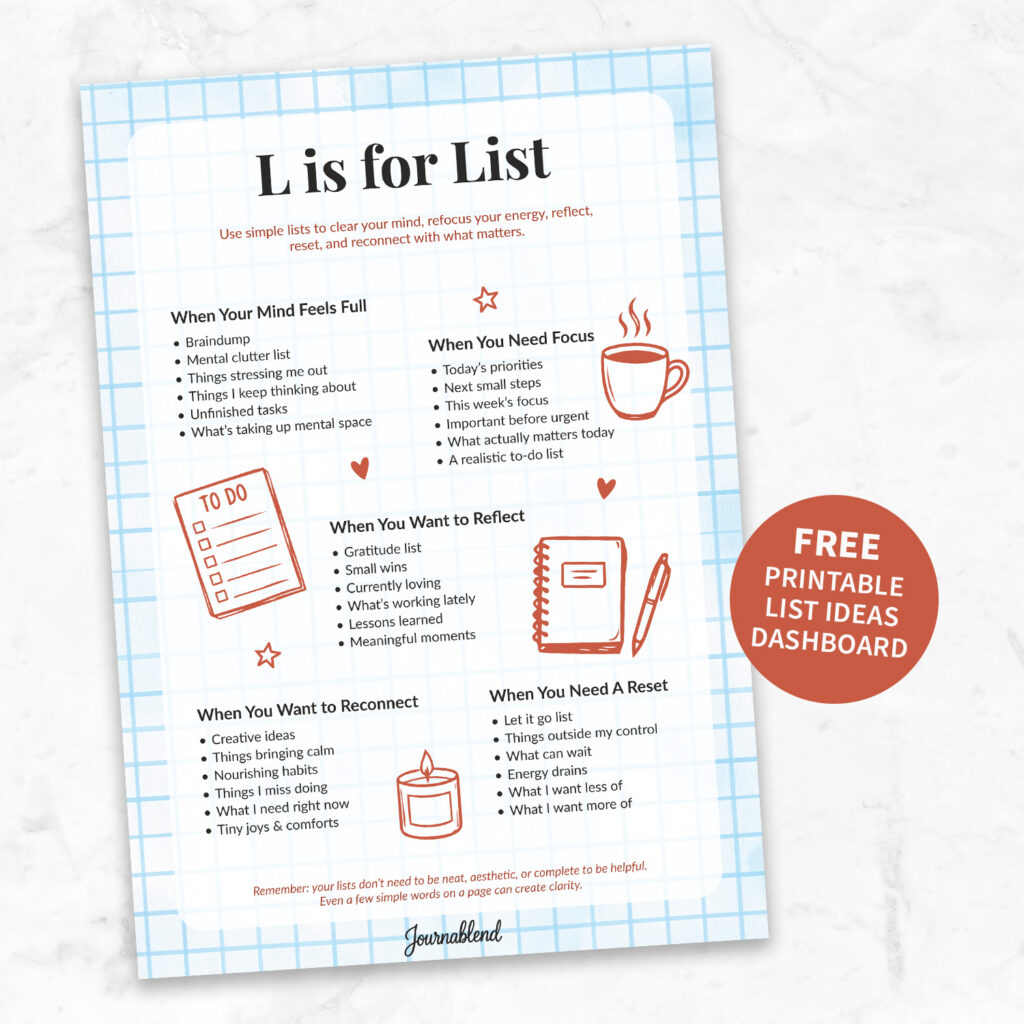
Because the List step can take so many different forms, I also created a free printable List Ideas Dashboard to tuck into your planner, journal, or Daily BlendBook.
It’s designed as a gentle reminder page filled with simple list ideas you can return to whenever you want to journal but aren’t sure where to begin.
Inside, you’ll find list prompts and inspiration for:
Rather than being a rigid worksheet, it’s meant to feel more like a supportive journaling companion – something you can quickly glance at whenever you need a little clarity, direction, or inspiration.
You can download the free dashboard printable from The Planner Lovers Resource Library, or my free Patreon membership.
One of my favorite things about journaling is that lists can take so many different forms.
Some are quick and practical, while others become reflective little snapshots of life.
In my own journaling practice, I use lists throughout both my dated planner and my Daily BlendBook, depending on what I need that day.
Here are a few of the types of lists I return to most often.
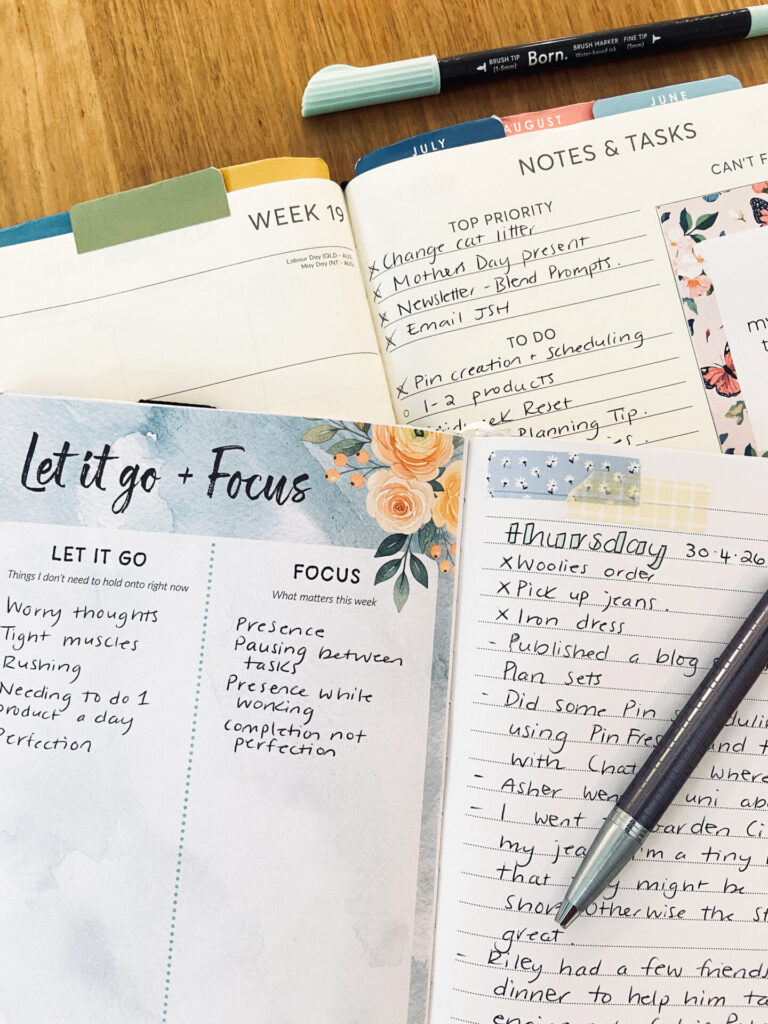
These are the lists that help me move through everyday life with a little more intention and a little less mental chaos.
In other words, they’re not endless productivity lists.
Instead, they’re simple reminders of what matters most today.
Sometimes I’ll write:
At the same time, I also often include softer things too:
Because of that, I like keeping these kinds of lists flexible and realistic rather than overwhelming.

In my Patreon Midweek Reset posts, I often share ways to pause and reconnect in the middle of the week instead of waiting until life feels completely out of control.
Naturally, lists are a huge part of that process for me.
For example, Midweek Reset lists might include:
Rather than making me feel pressured, these lists help me gently reset without feeling like I have to “start over.”
After all, sometimes all we really need is a small check-in and a little recalibration.

Similarly, I also use lists heavily during my Sunday Planning sessions.
However, this is usually less about strict scheduling and more about creating a soft sense of direction for the week ahead.
Depending on the week, I might create lists for:
Over time, I’ve found that I especially love creating simple focus lists rather than giant overwhelming master lists.
As a result, a smaller, intentional list often feels much calmer and more achievable.
This is also the approach behind my Pause + Plan collection of printable pages, which focuses more on soft direction and supportive list-making than strict productivity planning.
If you enjoy gentle weekly resets, flexible planning, and simple reflective lists, you can explore the collection here:
→ Pause + Plan printables on Etsy

One of the printable sets I’ve recently created for Etsy is the Let It Go and Focus List pages.
These were inspired by the way I naturally journal when my mind feels crowded or scattered.
More specifically, I often find that clarity comes more easily when I divide the page into two simple categories.
Things I don’t need to keep carrying.
This might include:
The things I actually want to give my energy to.
Interestingly, these are usually much simpler than I first expect:
Especially during overwhelming seasons, this kind of list can feel surprisingly grounding when life feels noisy.


Alongside these, I’ve also been creating “Currently” pages and journaling cards for Etsy, inspired by the kinds of reflective lists I naturally love making in my journals.
Shop Currently pages → Printable Currently pages on Etsy
Shop Currently card and pocket kits → Currently Cards on Etsy
Unlike traditional planning pages, these are less about productivity and more about capturing seasons of life.
Things like:
Personally, I love these because they become little snapshots of everyday life that are fun to look back on later.
At the same time, they also make journaling feel approachable on days when you don’t feel like writing long entries.

One thing I really want to emphasize is that your lists do not need to look aesthetic or perfectly organized to be useful.
In fact, some of my most helpful lists are scribbled quickly in the middle of a messy day.
The goal isn’t perfection.
Instead, the goal is support.
A list can simply be:

Ultimately, that’s really what this part of The Blend Flow is about for me.
Creating space.
Space between thoughts.
Space between overwhelm and action.
Space to notice what actually matters.
After the openness of the Braindump step, lists help bring gentle structure without becoming rigid or restrictive.
Little by little, they help transform mental noise into something clearer, calmer, and more manageable.
And often, that small shift is enough to help the rest of the day flow a little more smoothly.
So, if you’ve been wanting to journal more consistently but don’t know where to start, simple lists are honestly one of the easiest and most supportive entry points.
You don’t need elaborate spreads or perfect pages.
Just a notebook, a pen, and a little space to begin.
Remember to save or print the free List Ideas Dashboard and tuck it inside your journal for quick inspiration whenever you need it. Download it from The Planner Lovers Resource Library or Patreon.
Many of the pages shared throughout this post – including the Let It Go and Focus pages, Currently printables, and gentle planning pages – are available in my Etsy shops here:
Shop Space & Quiet → Space & Quiet
Shop The Lost Paperie →The Lost Paperie
They’re designed to support calm, spacious journaling and everyday reflection in a simple, approachable way.
Happy journaling x